Wednesday, March 21, 2012

Odds & Ends from My Media Travels

Crowdsourcing

Found this great article about crowdsourcing by Dan Wood on the Forbes site (of all places). Wood believes the concept of crowdsourcing is seriously misunderstood: “. . . in the minds of millions of people, the word crowdsourcing has created an illusion that there is a crowd that solves problems better than individuals.”
Finally, someone has called out crowdsourcing for what it really is. My favorite snippet came at the end:
“Karim R. Lakhani, an assistant professor at Harvard Business School, calls what most people refer to as crowdsourcing ‘broadcast search.’ A problem statement is broadcast along with associated incentives, and people with expertise apply their talent to solving the problem. I like the term virtuoso search better. Whatever term we use, let's not call it crowdsourcing and pretend that 10,000 average Joes invent better products than Steve Jobs.”
Ageism
After all the comments my original post ("Too Old to be a Designer?") here and on the Creative Freelancer blog got almost a year ago, others in the media are catching up. In the 3/19 edition of Newsweek, Rebecca Dana writes about the likes of Warren Buffet  and Paul McCartney, who are both refusing to quit working, and cites the same Barclay’s survey about “never-tirees.” And this was from good old Seth the other day:
Baby boomers continue to redefine our culture, because there's just so many of us, we're used to being the center of attention.
Add into that the fact that we're living much longer and careers are becoming more flexible and it's pretty clear that in just about every cultural respect, fifty year olds are living, acting and looking more like thirty year olds every day.
This changes more than personal financial planning. It changes the marketing of every service and product aimed at consumers--and yet most traditional advertisers are stuck in the mindset that thirty is the end of your chance to find a new customer or build a new brand.
Well said, Seth – you rock.

Monday, March 12, 2012

We Aren't Selling Shoes or Fuzzy Kitties, Folks

On a designers’ forum the other day, a fellow designer had a question about how to avoid endless “let’s try this” requests when a client is presented with a design draft. The question was really about how best to manage the client side of a design process, something many of us learn the hard way. So I gave her the advice I wish someone had given me years ago: 

Expectations have to be clear on both sides, and for that you must have a specific scope of work and a creative brief that have both been approved by the client. These will be your best tools for avoiding the dilemma of open-ended change orders. The purpose of these clarifications is so that you can control the process. It is true that you are working for the client, but once hired and with the above documents in hand, it is your job as a professional to make sure the project proceeds properly. Clients (generally) aren’t equipped to do this – that’s part of what they hire us to do.

A defined scope of work (including a specified number of approval rounds) will allow you to say, “I would be happy to make these changes. However, they will constitute a scope change. Would you like me to give you a quote for the extra work?” Clients often assume that looking at drafts is like buying shoes: they get to try new ones on ad infinitum until “they are happy.” You have to be clear about the difference – part of our job is to avoid wasting time by trying ideas that we know are not going to work, without alienating clients.

A signed-off creative brief will allow you to say, “I understand that the idea of adding a fuzzy kitty to the home page seems appealing. However, according to the goals you approved in the creative brief, this addition would destroy your credibility with your target audience.” That makes them aware that they will be solely responsible for the results of their own bad ideas. When you bring these issues out in the open in a professional way, you will be better able to guide your client to productive decisions.  

As to showing drafts: I NEVER EVER send drafts to clients for them to look at on their own. This is a sure road to disaster. It is absolutely imperative that you walk them through the work, whether in person or on the phone. You must be on hand to explain your thinking and head off any fuzzy-kitty ideas. If I can’t meet in person, I let clients know their draft is ready and set up a phone meeting. I email the pdf 5 minutes before our meeting time. I can then explain why I did what I did in a way that discourages tangents (“What about horses? I want to see a horse!”), and show how it supports the goals in the creative brief. We are both able to ask questions, make suggestions and get/give feedback in real time.  

The main cause of wrong turns and misunderstandings in a design process are the assumptions that fill the void created by a lack of clarity. For designers, that is job one and it begins at home. Nature abhors a vacuum and never more so than when it is caused by poor communication.

Tuesday, February 14, 2012

Form vs. Substance

Recently, my area’s only daily, the Peninsula Daily News, was purchased by a Canadian newspaper conglomerate. In an interview, a company representative was very clear about their mission: “We are not in the business of putting ink on paper. We are in the business of providing our readers with timely, relevant news and information that can make a difference in their lives.”
I found this statement striking because it expressed the company’s laser focus on what its product really is. It reminded me that all too often we confuse what we’re getting with the means by which it’s delivered – the classic form vs. substance dilemma.
Those of us in the design world push against this daily. Many of our clients assume that we produce pretty pictures, shiny brochures and flashy web sites because that’s what they see. This is partly because the processes we use are invisible to clients, who only see the end result. This affects other professional services as well.
The confusion also exists because we often don’t define our product with as much clarity as the newspaper described above. We have to do a better job of conveying our true product: thoughtful and strategic marketing tools that communicate our clients’ value. I think a way to clear this up in clients’ minds is to describe our services and products in terms of the benefits they deliver, not in terms of what they are made of.
So attorneys might describe their product as a thoughtfully structured estate plan that protects one’s heirs, not as a 5-page will. An accountant might position tax services as a means to preserve capital and stay out of trouble with the IRS, not as a filled-out 1040. A doctor delivers life-saving diagnoses, not 10 minutes in an exam room.
With the growth of online do-it-yourself/quick-and-dirty options for professional services, it is more necessary than ever for us to clearly state our value in the form of our services' benefit to our clients. Otherwise they will have little basis for choosing between WebMD and their primary care provider, H&R Block and their accountant, or CrowdSpring and their designer.

Monday, January 23, 2012

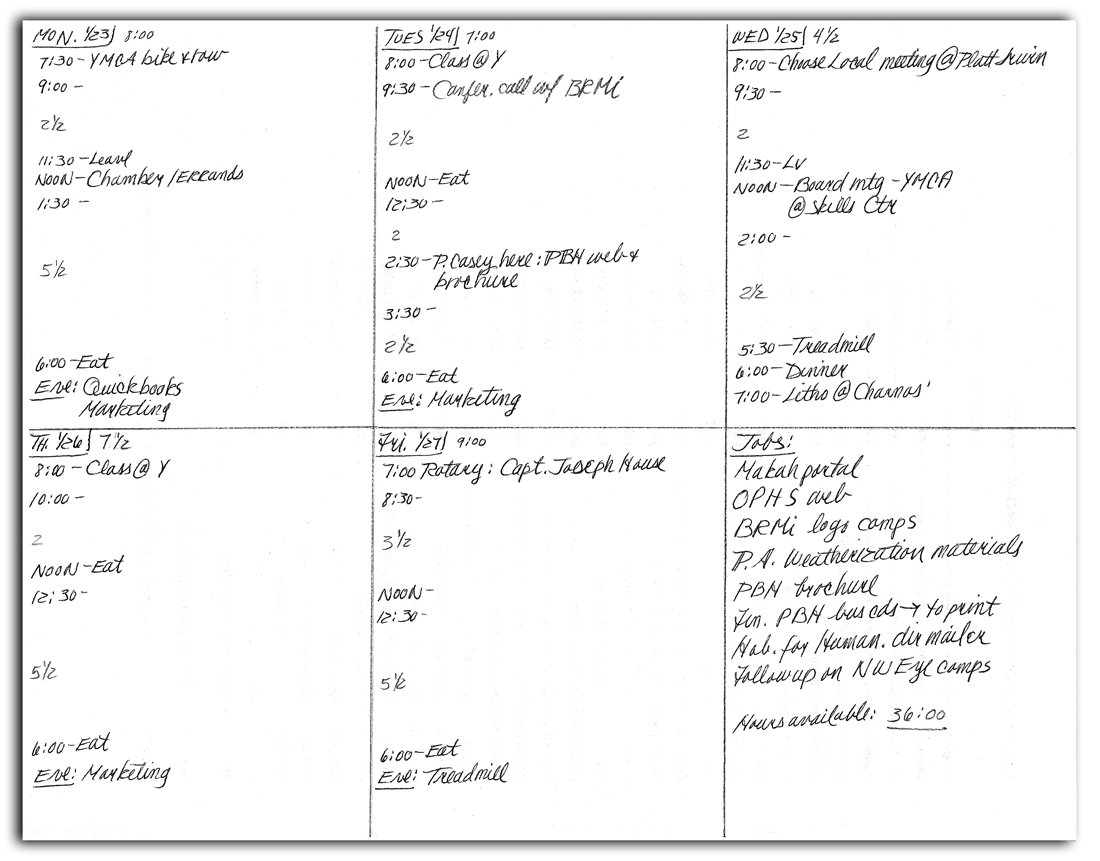
Time Management the Luddite Way

I seem to be off to a rocky start with my 2012 goal to write blog posts regularly, so some thoughts on time management seemed appropriate. Even with all the new devices and apps for managing time, we can still feel overwhelmed with the sheer volume of our To-Do’s, relative to the amount of time we have to do them in. Planning is the best way to avoid where-do-I-start paralysis, and keeping it uncomplicated is always better than overthinking. Here's a dirt-simple method that has stood me in good stead for years. In essence it is a semi-fancy list.
At the beginning of every week, I take a piece of paper out of my printer and fold it into thirds and again into half. I then have 6 squares. Five are labeled Monday through Friday with their respective calendar dates, and the sixth is where I put a list of job tasks that have to be worked on that week. I then prioritize those in order of how soon they're due by numbering them. Then I look in my day planner for meetings, deadlines, etc. and write them down with their hour times in the appropriate day box. I include things like when I'm going to go to the Y and anything else that is important (like a doctor’s appointment). I now have the whole week spread out in front of me and I can see at a glance how much work time I have (provided I don't goof off playing Minesweeper and reading blogs). As things come up, I erase and revise. Easy peasy. Takes about five minutes, nothing to install and it never crashes.
Yes, I know it is paper-based and seems dorky, especially when everyone else is tapping away on their devices. But the short act of doing this gives me a sense of order and control that makes it easier to get to work. All I have to do to get going is that one thing at the top of the list - take that, paralysis! The physical act of writing makes it real. I have a simple visual I can carry around in my pocket for fast reference, and it boots up really fast. I find it empowering and calming at the same time. Consider giving it a shot.

Tuesday, January 3, 2012

How to Hire a Designer

Happy New Year! One of my resolutions for 2012 is to post more regularly on Laurel’sDesignDeli, and to that end, today I’m sharing a post I read recently by Steve Guy on the Spark Design Professionals Forum on LinkedIn. Steve shared his thoughts on what he would look for in hiring a freelancer. It seemed to be oriented toward agencies hiring outside help, but I felt his excellent points were applicable for businesses hiring independent designers as well. So as you contemplate new projects for the coming year, these guidelines will prove invaluable.
I am really grateful for Steve’s permission to repost his essay. View his work at http://www.grafk.com/

If I were considering hiring a designer, here's what I'd look for:
1. Technical competence - Can they do the job? Ask them what software they use, what type of computers or printers? Are they reasonably current?
2. Creative talent - Does their portfolio inspire confidence that they can do a project for a client they've never worked with before with excellence?
3. Do they understand your business, or can they learn? Most importantly, are they willing to learn? A really good designer will not only learn about your company, but with time be able to give you recommendations based on their knowledge. You can find out if they are this type of designer by asking simple questions about their past projects, such as how they managed them and where they got their ideas.
4. Does the designer have a feel for sales and marketing? Unless your business IS an art show, this is NOT an art show, so your designer needs to understand that your primary goal is to grow your business. We all have an artsy side, but business needs often trump artistic considerations. A great designer understands the balance between the "art" and the "function" and is able to reconcile the two to your advantage, not his/hers.
5. How adept are they at technology sharing? Do they use DropBox, YouSendIt or similar to give you access to large files? Can they use GoToMeeting or similar to share their screen with you while on the phone, so you can see their work and discuss it in real time? The advantage of technology like this has made working with designers nearly seamless for those who embrace the tech.
These questions are best answered by direct inquiry and a review of their online portfolio, or by soliciting a pdf showing specific examples of the type of work you need. Often companies fail to let a potential contractor know the nature of the work needed, leaving the freelancer shooting in the dark when sending samples. The more specific you are about your needs/wants, the better chance you'll have of finding the right person. Also, designers’ full capabilities are seldom limited to what’s in their portfolio. Look carefully at their creative process and their ability to adapt, and you may just find your ideal candidate, even though they've never done "your exact type of work" before.
While the above is important from a fundamental standpoint, the following points are equally as important in finding a match. Every freelancer has their business ups and downs. Obviously if they are connecting with you even at your behest, they can take on the work now. But:
What about three months from now?
What is their typical work load?
Do they sub to other designers when there is too much work and not enough time? Ask how they managed multiple projects at the same time to completion.

Working with a designer should not be like a bad marriage. It is like any other relationship in that it will have occasional challenges, but you would be wise to consider the following:
1) What is their basic personality? Is the designer uptight, inflexible or easily rattled by last minute changes? All designers have had clients who pushed to the max on that one, but in general, a relaxed "no problem" attitude is best.
2) Does he/she have a good handle on how to give feedback to the client (you) when your design edits cross the line into bad design? This is REALLY important. Designer’s egos should not be tied to their work, and they should be open to multiple revisions. But, and this is a big one, you also need to have someone with enough experience to know how to tactfully give you feedback when your latest modification "in their professional opinion" breaks fundamental rules of either design, marketing, or presentation (or all three). Much success in this area is found in designers who have a wide range of experience in corporate accounts, small business and individual work. Designers with this experience will have had much exposure to many personalities/companies, giving them the skills to handle this type of feedback. This is a key component of the working relationship that will have a serious effect on how successfully you work together.
3) Lastly, are they fun to work with? I don't mean they take three hours of your day every time you talk on the phone re-living their last trip to Las Vegas, but do they have personality? Are they the type of person you'd like to have a drink with? Do you share a similar since of humor? These are the qualities of people who are easily liked, and as such tend not to be a PITA to work with. It cannot be overstated how important this type of chemistry is to a long-term working relationship.
I hope this helps and gives you some ideas in your search! Good luck!

Monday, December 12, 2011

Making My Peace with Age(ism)

Got invited to do a guest post on Kevin Bryce's Fresh Garbage blog about my take on the aging issue and how it affects the design world:

"Graphic Design is unique among the professions in many ways, and one of the most striking is the lack of gravitas accrued by practitioners as they gain experience. With lawyers and accountants, for example, their perceived value increases in relation to their years of practice. In the field of design, however, it is well understood that if you are much over 40 or 50, the likelihood of being hired by an marketing or advertising agency is remote. One could almost say it is inversely proportionate to the number of years one gets beyond the magic four-o."  Read the rest here and be sure to comment!

Tuesday, November 22, 2011

Back in the Saddle

Sorry for the long hiatus - it's been a busy month (hallelujah), and I have been responding to a lot of posts here and over at the CFC blog about crowdsourcing. This topic just keeps getting more and more traction. The news du jour is that I did a podcast with Ilise Benun of Marketing Mentor a couple of days ago on the subject of CS, and it's available for listening here. I hope you'll give it a listen and then chime in with your comments below.