Monday, January 23, 2012

Time Management the Luddite Way

I seem to be off to a rocky start with my 2012 goal to write blog posts regularly, so some thoughts on time management seemed appropriate. Even with all the new devices and apps for managing time, we can still feel overwhelmed with the sheer volume of our To-Do’s, relative to the amount of time we have to do them in. Planning is the best way to avoid where-do-I-start paralysis, and keeping it uncomplicated is always better than overthinking. Here's a dirt-simple method that has stood me in good stead for years. In essence it is a semi-fancy list.
At the beginning of every week, I take a piece of paper out of my printer and fold it into thirds and again into half. I then have 6 squares. Five are labeled Monday through Friday with their respective calendar dates, and the sixth is where I put a list of job tasks that have to be worked on that week. I then prioritize those in order of how soon they're due by numbering them. Then I look in my day planner for meetings, deadlines, etc. and write them down with their hour times in the appropriate day box. I include things like when I'm going to go to the Y and anything else that is important (like a doctor’s appointment). I now have the whole week spread out in front of me and I can see at a glance how much work time I have (provided I don't goof off playing Minesweeper and reading blogs). As things come up, I erase and revise. Easy peasy. Takes about five minutes, nothing to install and it never crashes.
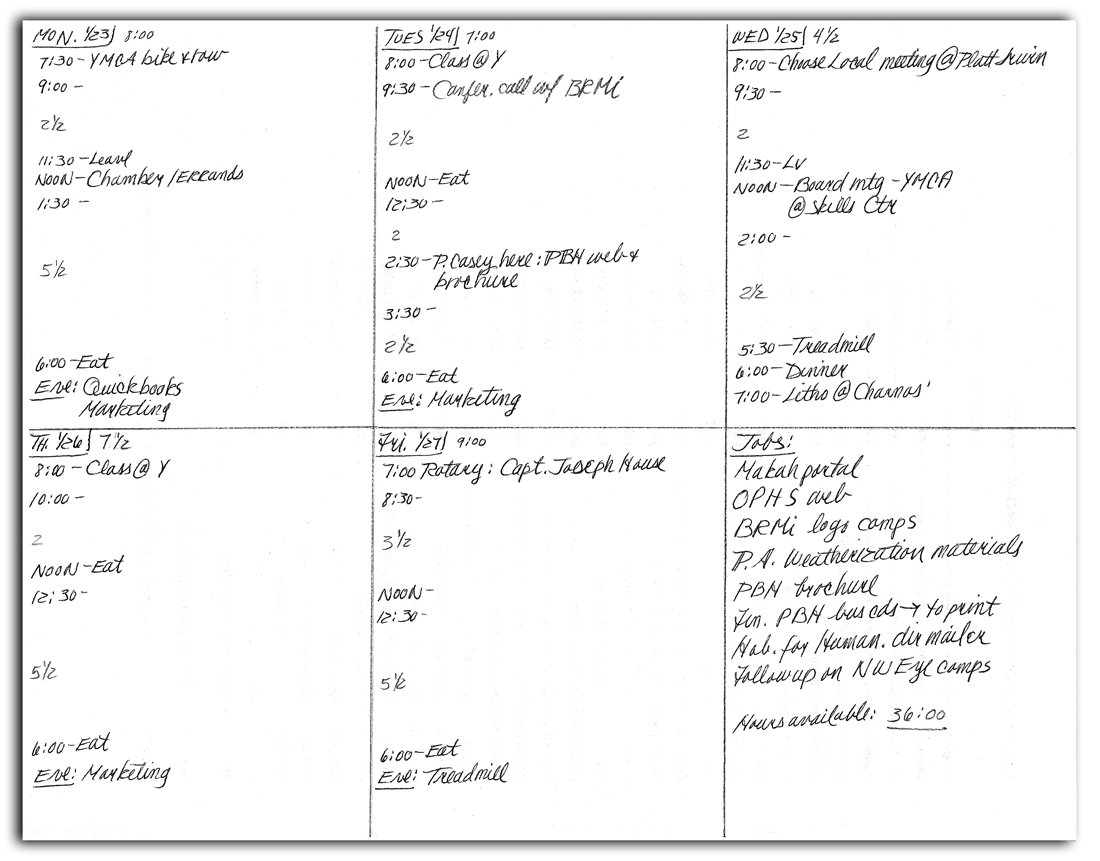
Yes, I know it is paper-based and seems dorky, especially when everyone else is tapping away on their devices. But the short act of doing this gives me a sense of order and control that makes it easier to get to work. All I have to do to get going is that one thing at the top of the list - take that, paralysis! The physical act of writing makes it real. I have a simple visual I can carry around in my pocket for fast reference, and it boots up really fast. I find it empowering and calming at the same time. Consider giving it a shot.

Tuesday, January 3, 2012

How to Hire a Designer

Happy New Year! One of my resolutions for 2012 is to post more regularly on Laurel’sDesignDeli, and to that end, today I’m sharing a post I read recently by Steve Guy on the Spark Design Professionals Forum on LinkedIn. Steve shared his thoughts on what he would look for in hiring a freelancer. It seemed to be oriented toward agencies hiring outside help, but I felt his excellent points were applicable for businesses hiring independent designers as well. So as you contemplate new projects for the coming year, these guidelines will prove invaluable.
I am really grateful for Steve’s permission to repost his essay. View his work at http://www.grafk.com/

If I were considering hiring a designer, here's what I'd look for:
1. Technical competence - Can they do the job? Ask them what software they use, what type of computers or printers? Are they reasonably current?
2. Creative talent - Does their portfolio inspire confidence that they can do a project for a client they've never worked with before with excellence?
3. Do they understand your business, or can they learn? Most importantly, are they willing to learn? A really good designer will not only learn about your company, but with time be able to give you recommendations based on their knowledge. You can find out if they are this type of designer by asking simple questions about their past projects, such as how they managed them and where they got their ideas.
4. Does the designer have a feel for sales and marketing? Unless your business IS an art show, this is NOT an art show, so your designer needs to understand that your primary goal is to grow your business. We all have an artsy side, but business needs often trump artistic considerations. A great designer understands the balance between the "art" and the "function" and is able to reconcile the two to your advantage, not his/hers.
5. How adept are they at technology sharing? Do they use DropBox, YouSendIt or similar to give you access to large files? Can they use GoToMeeting or similar to share their screen with you while on the phone, so you can see their work and discuss it in real time? The advantage of technology like this has made working with designers nearly seamless for those who embrace the tech.
These questions are best answered by direct inquiry and a review of their online portfolio, or by soliciting a pdf showing specific examples of the type of work you need. Often companies fail to let a potential contractor know the nature of the work needed, leaving the freelancer shooting in the dark when sending samples. The more specific you are about your needs/wants, the better chance you'll have of finding the right person. Also, designers’ full capabilities are seldom limited to what’s in their portfolio. Look carefully at their creative process and their ability to adapt, and you may just find your ideal candidate, even though they've never done "your exact type of work" before.
While the above is important from a fundamental standpoint, the following points are equally as important in finding a match. Every freelancer has their business ups and downs. Obviously if they are connecting with you even at your behest, they can take on the work now. But:
What about three months from now?
What is their typical work load?
Do they sub to other designers when there is too much work and not enough time? Ask how they managed multiple projects at the same time to completion.

Working with a designer should not be like a bad marriage. It is like any other relationship in that it will have occasional challenges, but you would be wise to consider the following:
1) What is their basic personality? Is the designer uptight, inflexible or easily rattled by last minute changes? All designers have had clients who pushed to the max on that one, but in general, a relaxed "no problem" attitude is best.
2) Does he/she have a good handle on how to give feedback to the client (you) when your design edits cross the line into bad design? This is REALLY important. Designer’s egos should not be tied to their work, and they should be open to multiple revisions. But, and this is a big one, you also need to have someone with enough experience to know how to tactfully give you feedback when your latest modification "in their professional opinion" breaks fundamental rules of either design, marketing, or presentation (or all three). Much success in this area is found in designers who have a wide range of experience in corporate accounts, small business and individual work. Designers with this experience will have had much exposure to many personalities/companies, giving them the skills to handle this type of feedback. This is a key component of the working relationship that will have a serious effect on how successfully you work together.
3) Lastly, are they fun to work with? I don't mean they take three hours of your day every time you talk on the phone re-living their last trip to Las Vegas, but do they have personality? Are they the type of person you'd like to have a drink with? Do you share a similar since of humor? These are the qualities of people who are easily liked, and as such tend not to be a PITA to work with. It cannot be overstated how important this type of chemistry is to a long-term working relationship.
I hope this helps and gives you some ideas in your search! Good luck!

Monday, December 12, 2011

Making My Peace with Age(ism)

Got invited to do a guest post on Kevin Bryce's Fresh Garbage blog about my take on the aging issue and how it affects the design world:

"Graphic Design is unique among the professions in many ways, and one of the most striking is the lack of gravitas accrued by practitioners as they gain experience. With lawyers and accountants, for example, their perceived value increases in relation to their years of practice. In the field of design, however, it is well understood that if you are much over 40 or 50, the likelihood of being hired by an marketing or advertising agency is remote. One could almost say it is inversely proportionate to the number of years one gets beyond the magic four-o."  Read the rest here and be sure to comment!

Tuesday, November 22, 2011

Back in the Saddle

Sorry for the long hiatus - it's been a busy month (hallelujah), and I have been responding to a lot of posts here and over at the CFC blog about crowdsourcing. This topic just keeps getting more and more traction. The news du jour is that I did a podcast with Ilise Benun of Marketing Mentor a couple of days ago on the subject of CS, and it's available for listening here. I hope you'll give it a listen and then chime in with your comments below.

Monday, October 17, 2011

Crowdsourcing: Confronting the Deception

Independent creatives continue to bemoan the effect of crowdsourcing on our ability to make a living, and the main driver seems to be a toxic confluence of globalization and recession. I have recently concluded that a big chunk of the persistence of crowdsourcing (CS) rests on the Deception of Equal Value. Clients unconsciously assume that crowdsourced "design" is equal in value to the services of experienced professionals, both in the design’s quality and in its ability to do the job for clients, i.e., sell their stuff.
The CS sites encourage this deception with their slick come-ons, and unless we proactively take this bull by the horns, clients will remain in the dark and keep buying CS crap. Some of the sites go so far as to imply that professional designers are ripping off the business community. We ignore this at our peril. Letting CS sites control the messaging around design is a huge mistake.
We have to reclaim control of this communications lapse. Just as some have no clue about the difference between a certified  accountant and H&R Block, many businesses have no idea what it takes to create a marcom piece that attracts and converts successfully. Not only do they assume that $100 graphic doodads are equal in value to professional, strategic designs, they assume that those doodads will deliver the same results. If we professionals don't tell them the difference, how will they know?
And herein lies an opportunity:  many of us have clients who provide services. They, too, are being hit by their own versions of crowdsourcing. The Deception of Equal Value is a challenge to all professional service providers. Ask your lawyer how she feels about online DIY contracts. Ask your doctor how he likes it when patients self-diagnose with WebMD. Globalization and CS has come to all the professions, like it or not, and it is having the effect of commoditizing a lot of previously specialized work. Creatives can lead the way in demonstrating how to deal with this.
So it’s up to us to communicate the meaning of true value, to and for our clients. It can feel tedious, but explaining gets easier the more you do it. As many have pointed out, this also means that we have to sell ideas and not just products. If we demonstrate our own value case, it shows we can make the same case for our clients.
[Caution: Sounding even a little annoyed at having to explain will be noticed on some level by your client and will not help make your point.]
Of course, there will always be people who shop solely on price. They will be with us whether the economy is bad or thriving. I continue to believe that there are enough clients who rank value over price that we can all survive. But it will take effort on our part to find them, connect with them and demonstrate our long-term worth beyond the project level.

Tuesday, September 20, 2011

Good News on the Logo Front

I'm happy to report that last week I learned that three of my logos were awarded recognition in two competitions! The venerable GD:usa annual awards chose these two:


LogoLounge, an online portfolio and tool for logo research, discussion, inspiration and reference chose this one for inclusion in its 2012 book of logos:


I really appreciate this recognition - there are a ton of great designers out there and I'm thankful to have been included with them. Definitely a good week!

Thursday, September 15, 2011

Advice from Anne

The last comment on the previous post was from  Anne C. Kerns, AIGA who closed by referring to another comment she made in reply to the plight voiced by Anonymous in Joplin on the original crowdsourcing post. Mysteriously, it kept disappearing, so because I thought it was excellent advice, I am making it available as a regular post. Thanks for sharing your insights, Anne!

I am a self-employed designer. I don't do spec work or contest work. If I work for free, it's because I choose to donate my services, unique outlook, and skills for a cause or organization I support. (When in doubt, refer to www.shouldiworkforfree.com)

@Anonymous near Joplin, MI:

I am sorry for your situation. If you have time to do contest-type work that doesn't pay, then you have time to do the things that can change your situation.

Why not put all that thought and research into developing a business model where you pick an industry, develop a portfolio, and then pitch it to actual paying clients.
or
Redesign some poorly-designed materials and pitch those to those businesses.
or
Pick a problem in the world. Design a piece that educates or advocates. Pitch it to the organizations that address that problem.
or
Go to the library and check out some marketing and self promotional books.
or
Ask to borrow another designer's marketing and self promotional books.
or
Call the institution you graduated from and find out if there are networking events, or job hunting advice, or career fairs.
or
Find a business mentor. Barter design services.
or
Partner with another un- or underemployed graphic designer and support and coach each other with real ideas, not complaining. Same time every week. Set goals.
or
Write and illustrate a children's book and sell it on Lulu.com or Amazon.
or
Make illustrations and sell them to a stock image company.
or
Make illustrated portraits of people (or children, or pets) and start a web business doing custom portraits.
or
Start a unique creative project, put it on the web, tweet about it, and watch it spread like wildfire. Many personal projects have turned into paying work or books -- dailymonster.com, postsecret.com, stuffwhitepeoplelike.com, typographyforlawyers.com, dailydropcap.com, thisisindexed.com, gapingvoid.com
or
Come up with a Kickstarter idea and write an awesome proposal to get it funded.
or
Do more than just one of the above.

You obviously have internet access since you posted a comment on a blog, why are you limiting yourself to Joplin? You can work for clients anywhere these days.

Good luck -- make your own.