Wednesday, September 19, 2012

Bigger Isn’t Better, It’s Just More Expensive

As a one-person design firm, I have always been content with my decision to be a solo practitioner. Especially in recent years, the opportunity to collaborate and create fluid creative teams has increased, making bidding on larger and more complex projects a lot more feasible. However, there has been a lag between the expanded capabilities of independent contractors, and how these are perceived by some clients. Many of us have been unfavorably compared to large agencies due to assumptions about their supposed greater benefits.

Big agencies have historically cultivated images of greater power, sophistication and resources. They also have the ability to convey a sense of status seldom associated with small firms. I think respect for independents is on the rise because more and more clients are starting to realize the following:

Big agencies prefer big clients. The status thing works in both directions. If you’re not the client bringing in the most revenue, that can have an effect on how your project is prioritized. As more and more professionals start their own ventures, those that don’t fit the ideal client model of the big firms may not register on their radar. The good news is, there are also increasing numbers of excellent small firms who provide agency-level work.

Big agencies charge more to cover their higher costs. Large staffs have to be paid regularly. They also have to be housed in large offices with all the necessary support. Maintaining a large firm with a massive overhead is a monster that has to be fed constantly. That creative director you’re meeting with? He may make $100/hour or more, but you’re paying his firm upwards of $300/hour just to sit in the same room.  And he probably won’t be doing your work – that will be done by a junior or mid-level designer who makes a fraction of the CD’s salary.

Big agencies hand off work to junior associates. Usually, senior management focuses on developing new business. Once clients are landed, they often get shuttled to junior associates. This can happen anywhere, but the larger the firm, the more prevalent the practice can be. At a smaller agency, the person you signed with will typically be the person who works on your project and will nearly always be responsible for your project and with whom you will work.

Big agencies are less nimble. Large staffs also mean that you will have layers of management to deal with that don’t exist in a smaller firm. Because of their scale, large firms tend to be less agile than smaller ones. This can be a problem with the ever-increasing rate of change in the business world. Fewer people mean less bureaucracy and more flexibility.

Big agencies can no longer claim a technology advantage. The competitive advantage big agencies once had in research has been eclipsed by online tools available to firms of any size. Technology has made the monopoly big firms used to have on these resources a thing of the past. 

The use of big agencies is being questioned in many quarters for good reason. Responsiveness, flexibility, working with a senior creative, less management, way lower overhead (with resulting lower fees) and a level technology playing field mean that you have a lot more options than before. Obsolete assumptions can be expensive. 

When it’s time for your next design project, go small.

Sunday, August 26, 2012

Newsletters: An Effective Way to Stay in Touch


On one of the forums I follow, there was a conversation about the best way to reach out to clients for new work, whether directly or as referral sources. The consensus was that they are a rich resource if approached correctly. Some felt that individualized outreach worked well. 

For me personally, I have had very good response to my (mostly) monthly newsletter. I have found it to be an efficient way to remind my client base that I can help them with their design and communications challenges in more ways than one.  The forum was for designers, but I think the principles hold for any professional service. Here is what I said:

Creating content that is meaningful and useful to your readers is at the core of newsletter effectiveness. So you need a very good handle on what motivates your readers and what their problems are. They are not interested in your accomplishments, except as it relates to the problems they want to solve. I have read that newsletter content should be no more than 15-20% promotional. I had mine down to less than 5%, and still got feedback that it was too “sales-y.” So now I let my readers connect their own dots and confine anything about me to a column about what I’m currently working on. Readers are quite able to see from that that I can provide services beyond what they may have already gotten from me.

My last newsletter had an example of content intended to be immediately useful to clients. It was about how not to make design decisions in a group setting. Besides being applicable to other types of decision-making, it was an opportunity to train my clients to behave in ways that work for me and also get them the best results. Besides having a pretty good open rate, I have gotten several positive emails about the article, which is usually the norm.

As far as tracking goes, if you use the MyEmma newsletter service, the stats are generated automatically and easily accessed. I have used Emma for over two years with great satisfaction. They have been especially helpful in customizing the template I use, and their customer service is great.

If you would like to see how I do my newsletter, this is a link to the last one, shown above.
 
And of course feedback and critiques are always welcome!

Wednesday, July 11, 2012

Two Great Blogs

It’s been uncharacteristically busy lately. You would think it would slow a bit as summer comes on, and it did for a minute. Then it went right back to normal, which around here is low-level crazed. In the smallish interval, I got acquainted with two blogs that I think are very worth sharing.

The first one is by a colleague, Julia Reich of Julia Reich Design in western New York. Like me, she practices in a fairly remote area. Recently she led a roundtable on the joys (or not) of being a designer in the sticks at the annual Creative Freelancers Conference. Wish I could have been there, but her report makes up for it. Read it here: http://juliareichdesign.com/category/blog/

The other blog is (ahem) my daughter’s new blog. Lest you think that the only ism for me is nepotism, I have never been a slavishly adoring mom, as Caitlin will be the first to tell you. I do think she has a great talent for writing, and since she seems to have inherited the Snarky gene, she’s quite amusing. She has many insights into the life of a young urban 20-something. Check her out here: http://caitlinface.com/

Tuesday, June 12, 2012

The Dynamics of Social Media

I ran across this infographic on a Pinterest board just now and was amazed at how well and succinctly it sums up the mystifying relationships among the principle social media. Up to now I believe this issue has largely been the province of academia and Wall Street, so of course I had to share it with my faithful readership.I do wonder where LinkedIn would fit in here, but apparently it isn't a big enough waster of time, or else has insufficient scope for work avoidance.

It looks to be the creation of a site called despair.com (hard to see that tiny gray attribution at the bottom). They seem to be the inventors of demotivational posters as well. Kudos to them for pushing back the frontiers of snark.

Tuesday, May 8, 2012

Cheap Design is Expensive

I just sent out my quasi-monthly newsletter, and since there doesn’t seem to be a lot of overlap between my blog buddies and my newsletter list, I thought I would also post it here. Let me know what you think!

I was contacted recently by a business owner who wanted to place an ad in a magazine with a looming deadline. The owner said he wanted me to just resize an old ad and wasn’t interested in making any changes. Upon questioning him further, it appeared that the old ad had not been effective, but since another publication had put it together for him for free, he felt he could get some more mileage out of it.
I tried to explain that putting little or no thought into the content and look of an expensive display ad would make the ad basically useless, but he wasn’t having any of it. He insisted that the important thing was to have a presence in the publication and that the ad’s message was adequate. He seemed to think that readers would just somehow “get” what his business was all about and that they would know what to do (even though the ad had no call to action). He felt that spending money on the content and appearance of the ad was a waste, and I should just resize it and be done. Since I have an allergy to selling people useless stuff, I passed on the job.
This experience is not unique. Everyone who has ever been in business has had to deal with customers who are overly focused on price, and the design and marketing professions are no different. This is especially true in an ailing economy – customers tend to focus on the bottom line because it feels like they live and die by it. But, as we know, it is a mistake to bring a short-term focus to a long-term challenge, and that is what happens when make-do patches are applied to marketing tools. Re-using something that didn’t work the first time just wastes resources that would be better applied to finding a real solution that supports business goals over the long term.
And other businesses have their versions of this. If you are an accountant, it’s “Cheap accounting is expensive,” and if you are a mechanic, it’s “Cheap repairs are expensive.” Your investment in expensive ad space, printing and web development will be wasted if budget resources are not first used for developing message and design. Get your strategic content in place, and you will receive a much better return on those investments.
So how about all of you? what's your version of "Cheap _____ is expensive"?

Friday, April 27, 2012

Know Where Your Stuff Comes From

I have long been a reader of GraphicDesign:usa, a respected design publication with a long history. In their recent Green Newsletter , the editor, Gordon Kaye, had an article called “Computers Don’t Grow on Trees.”  In it, he made the point that the assumption that digital is greener than paper is simplistic, and overdue for challenge and examination. He included a link to another article on the re-nourish site addressing the debate. I decided to respond with the following letter: 

Thanks for your lead editorial in the latest GDUSA Green Newsletter. It is really refreshing to finally see a more balanced picture of sustainability issues in a national design forum.

I live on the Olympic Peninsula in Washington State, where growing and harvesting trees has been a way of life for over 130 years. The region is still mostly covered by trees, and not just in Olympic National Park. Reforestation has been a standard forestry practice since the early 20th century, now mandated by state law and modern forestry methods.

I have found that most designers who live in urban areas have almost no understanding about forestry processes. I didn’t either until I moved here in the late 70’s. I am now married to a commercial forester who manages the oldest tree farm in our region, 125 years old and very productive. I was disappointed in the digital side of the article on the re-nourish site. Its characterization of tree farms had many inaccuracies. For instance, monoculture is not generally practiced; tree farms are managed to mimic natural processes as much as possible; many of them are privately held and by small business people; and forestry in Washington State is highly regulated with a set of rules called Forest Practices. Habitat degradation and pollution are not beneficial to good tree growth, and modern forestry practices reflect this, as shown in the Finch in the Forest blog. 

I think the real problem is that most people don’t think about where their stuff comes from – any of it, not just wood products. For instance, many take it for granted that food appears in the supermarket wrapped in plastic and ready to go, without wondering how that happened. I noticed that there was no mention of blood metals in the re-nourish article. Beating up on wood products is a lot easier than taking responsibility for the innards of our MacPros, or giving up our internal combustion vehicles. Of course we will all benefit in the long run by learning to live and work more sustainably, but hypocritical finger-pointing and simplistic generalizations are not going to get us there. I appreciate your integrity in trying to present all sides. 

So what do you all think? Do you know where your stuff comes from? 

(Go here to learn more about blood metals.)

Monday, March 26, 2012

How Much is a Donation Worth?

Last week on the radio, I heard a report comparing how much money the major presidential candidates have raised – how much from PACs and how much from small individual donors (the one-person variety). Apparently Obama has raised as much from individual small donors as Romney has from super PACs. The story went on to focus on comparing each campaign’s number of dollars as a metric for the relative strength of the candidates.
 I think they’re focusing too narrowly – where the dollars come from is far more significant as a measure of relative strength. This obsession with absolute numbers can also happen when evaluating online and social media marketing campaigns: the sheer quantity of hits is assumed to prove success. But the true metric is conversion. You can have a million hits, but if none of them converts to a sale, who cares?
It’s the same with dollars from a super PAC: how many of those will convert to actual votes? The conventional wisdom says that more advertising = more people converted. True up to a point, but I would argue that a dollar donated directly from a person who also has a vote to spend is far more valuable.
When people directly invest their own money in a cause, they are investing philosophically and emotionally. Otherwise their wallets would stay in their pants. I think the dollars raised from individuals is far more indicative of voter sentiment than voting projections extrapolated from an ad spend. If so, Romney’s huge war chest may be less powerful than Santorum’s smaller pile, because the latter is mostly from individuals. And Obama’s may trump them both because it has both quality (small donors) and quantity (most money).
I guess it will come down to a test of whether big-bucks advertising can trump voter investment. Since one influences the other, this will be interesting.

Wednesday, March 21, 2012

Odds & Ends from My Media Travels

Crowdsourcing

Found this great article about crowdsourcing by Dan Wood on the Forbes site (of all places). Wood believes the concept of crowdsourcing is seriously misunderstood: “. . . in the minds of millions of people, the word crowdsourcing has created an illusion that there is a crowd that solves problems better than individuals.”
Finally, someone has called out crowdsourcing for what it really is. My favorite snippet came at the end:
“Karim R. Lakhani, an assistant professor at Harvard Business School, calls what most people refer to as crowdsourcing ‘broadcast search.’ A problem statement is broadcast along with associated incentives, and people with expertise apply their talent to solving the problem. I like the term virtuoso search better. Whatever term we use, let's not call it crowdsourcing and pretend that 10,000 average Joes invent better products than Steve Jobs.”
Ageism
After all the comments my original post ("Too Old to be a Designer?") here and on the Creative Freelancer blog got almost a year ago, others in the media are catching up. In the 3/19 edition of Newsweek, Rebecca Dana writes about the likes of Warren Buffet  and Paul McCartney, who are both refusing to quit working, and cites the same Barclay’s survey about “never-tirees.” And this was from good old Seth the other day:
Baby boomers continue to redefine our culture, because there's just so many of us, we're used to being the center of attention.
Add into that the fact that we're living much longer and careers are becoming more flexible and it's pretty clear that in just about every cultural respect, fifty year olds are living, acting and looking more like thirty year olds every day.
This changes more than personal financial planning. It changes the marketing of every service and product aimed at consumers--and yet most traditional advertisers are stuck in the mindset that thirty is the end of your chance to find a new customer or build a new brand.
Well said, Seth – you rock.

Monday, March 12, 2012

We Aren't Selling Shoes or Fuzzy Kitties, Folks

On a designers’ forum the other day, a fellow designer had a question about how to avoid endless “let’s try this” requests when a client is presented with a design draft. The question was really about how best to manage the client side of a design process, something many of us learn the hard way. So I gave her the advice I wish someone had given me years ago: 

Expectations have to be clear on both sides, and for that you must have a specific scope of work and a creative brief that have both been approved by the client. These will be your best tools for avoiding the dilemma of open-ended change orders. The purpose of these clarifications is so that you can control the process. It is true that you are working for the client, but once hired and with the above documents in hand, it is your job as a professional to make sure the project proceeds properly. Clients (generally) aren’t equipped to do this – that’s part of what they hire us to do.

A defined scope of work (including a specified number of approval rounds) will allow you to say, “I would be happy to make these changes. However, they will constitute a scope change. Would you like me to give you a quote for the extra work?” Clients often assume that looking at drafts is like buying shoes: they get to try new ones on ad infinitum until “they are happy.” You have to be clear about the difference – part of our job is to avoid wasting time by trying ideas that we know are not going to work, without alienating clients.

A signed-off creative brief will allow you to say, “I understand that the idea of adding a fuzzy kitty to the home page seems appealing. However, according to the goals you approved in the creative brief, this addition would destroy your credibility with your target audience.” That makes them aware that they will be solely responsible for the results of their own bad ideas. When you bring these issues out in the open in a professional way, you will be better able to guide your client to productive decisions.  

As to showing drafts: I NEVER EVER send drafts to clients for them to look at on their own. This is a sure road to disaster. It is absolutely imperative that you walk them through the work, whether in person or on the phone. You must be on hand to explain your thinking and head off any fuzzy-kitty ideas. If I can’t meet in person, I let clients know their draft is ready and set up a phone meeting. I email the pdf 5 minutes before our meeting time. I can then explain why I did what I did in a way that discourages tangents (“What about horses? I want to see a horse!”), and show how it supports the goals in the creative brief. We are both able to ask questions, make suggestions and get/give feedback in real time.  

The main cause of wrong turns and misunderstandings in a design process are the assumptions that fill the void created by a lack of clarity. For designers, that is job one and it begins at home. Nature abhors a vacuum and never more so than when it is caused by poor communication.

Tuesday, February 14, 2012

Form vs. Substance

Recently, my area’s only daily, the Peninsula Daily News, was purchased by a Canadian newspaper conglomerate. In an interview, a company representative was very clear about their mission: “We are not in the business of putting ink on paper. We are in the business of providing our readers with timely, relevant news and information that can make a difference in their lives.”
I found this statement striking because it expressed the company’s laser focus on what its product really is. It reminded me that all too often we confuse what we’re getting with the means by which it’s delivered – the classic form vs. substance dilemma.
Those of us in the design world push against this daily. Many of our clients assume that we produce pretty pictures, shiny brochures and flashy web sites because that’s what they see. This is partly because the processes we use are invisible to clients, who only see the end result. This affects other professional services as well.
The confusion also exists because we often don’t define our product with as much clarity as the newspaper described above. We have to do a better job of conveying our true product: thoughtful and strategic marketing tools that communicate our clients’ value. I think a way to clear this up in clients’ minds is to describe our services and products in terms of the benefits they deliver, not in terms of what they are made of.
So attorneys might describe their product as a thoughtfully structured estate plan that protects one’s heirs, not as a 5-page will. An accountant might position tax services as a means to preserve capital and stay out of trouble with the IRS, not as a filled-out 1040. A doctor delivers life-saving diagnoses, not 10 minutes in an exam room.
With the growth of online do-it-yourself/quick-and-dirty options for professional services, it is more necessary than ever for us to clearly state our value in the form of our services' benefit to our clients. Otherwise they will have little basis for choosing between WebMD and their primary care provider, H&R Block and their accountant, or CrowdSpring and their designer.

Monday, January 23, 2012

Time Management the Luddite Way

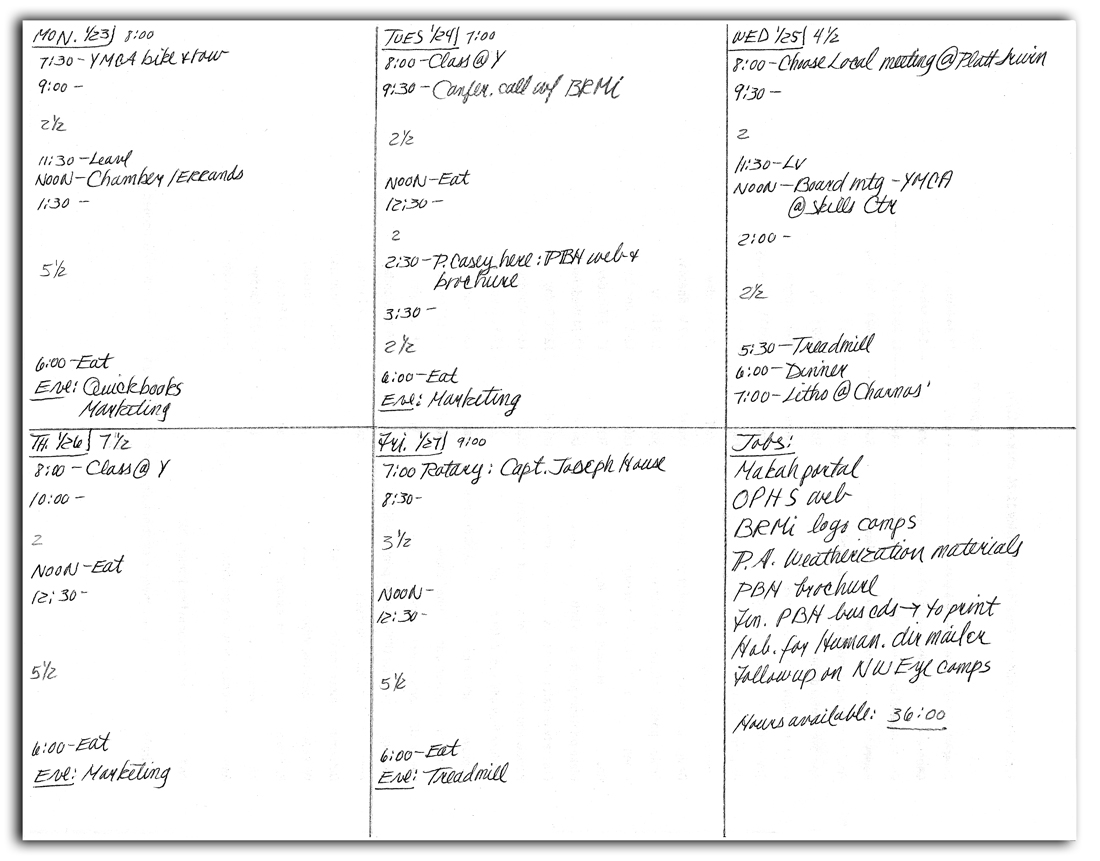
I seem to be off to a rocky start with my 2012 goal to write blog posts regularly, so some thoughts on time management seemed appropriate. Even with all the new devices and apps for managing time, we can still feel overwhelmed with the sheer volume of our To-Do’s, relative to the amount of time we have to do them in. Planning is the best way to avoid where-do-I-start paralysis, and keeping it uncomplicated is always better than overthinking. Here's a dirt-simple method that has stood me in good stead for years. In essence it is a semi-fancy list.
At the beginning of every week, I take a piece of paper out of my printer and fold it into thirds and again into half. I then have 6 squares. Five are labeled Monday through Friday with their respective calendar dates, and the sixth is where I put a list of job tasks that have to be worked on that week. I then prioritize those in order of how soon they're due by numbering them. Then I look in my day planner for meetings, deadlines, etc. and write them down with their hour times in the appropriate day box. I include things like when I'm going to go to the Y and anything else that is important (like a doctor’s appointment). I now have the whole week spread out in front of me and I can see at a glance how much work time I have (provided I don't goof off playing Minesweeper and reading blogs). As things come up, I erase and revise. Easy peasy. Takes about five minutes, nothing to install and it never crashes.
Yes, I know it is paper-based and seems dorky, especially when everyone else is tapping away on their devices. But the short act of doing this gives me a sense of order and control that makes it easier to get to work. All I have to do to get going is that one thing at the top of the list - take that, paralysis! The physical act of writing makes it real. I have a simple visual I can carry around in my pocket for fast reference, and it boots up really fast. I find it empowering and calming at the same time. Consider giving it a shot.

Tuesday, January 3, 2012

How to Hire a Designer

Happy New Year! One of my resolutions for 2012 is to post more regularly on Laurel’sDesignDeli, and to that end, today I’m sharing a post I read recently by Steve Guy on the Spark Design Professionals Forum on LinkedIn. Steve shared his thoughts on what he would look for in hiring a freelancer. It seemed to be oriented toward agencies hiring outside help, but I felt his excellent points were applicable for businesses hiring independent designers as well. So as you contemplate new projects for the coming year, these guidelines will prove invaluable.
I am really grateful for Steve’s permission to repost his essay. View his work at http://www.grafk.com/

If I were considering hiring a designer, here's what I'd look for:
1. Technical competence - Can they do the job? Ask them what software they use, what type of computers or printers? Are they reasonably current?
2. Creative talent - Does their portfolio inspire confidence that they can do a project for a client they've never worked with before with excellence?
3. Do they understand your business, or can they learn? Most importantly, are they willing to learn? A really good designer will not only learn about your company, but with time be able to give you recommendations based on their knowledge. You can find out if they are this type of designer by asking simple questions about their past projects, such as how they managed them and where they got their ideas.
4. Does the designer have a feel for sales and marketing? Unless your business IS an art show, this is NOT an art show, so your designer needs to understand that your primary goal is to grow your business. We all have an artsy side, but business needs often trump artistic considerations. A great designer understands the balance between the "art" and the "function" and is able to reconcile the two to your advantage, not his/hers.
5. How adept are they at technology sharing? Do they use DropBox, YouSendIt or similar to give you access to large files? Can they use GoToMeeting or similar to share their screen with you while on the phone, so you can see their work and discuss it in real time? The advantage of technology like this has made working with designers nearly seamless for those who embrace the tech.
These questions are best answered by direct inquiry and a review of their online portfolio, or by soliciting a pdf showing specific examples of the type of work you need. Often companies fail to let a potential contractor know the nature of the work needed, leaving the freelancer shooting in the dark when sending samples. The more specific you are about your needs/wants, the better chance you'll have of finding the right person. Also, designers’ full capabilities are seldom limited to what’s in their portfolio. Look carefully at their creative process and their ability to adapt, and you may just find your ideal candidate, even though they've never done "your exact type of work" before.
While the above is important from a fundamental standpoint, the following points are equally as important in finding a match. Every freelancer has their business ups and downs. Obviously if they are connecting with you even at your behest, they can take on the work now. But:
What about three months from now?
What is their typical work load?
Do they sub to other designers when there is too much work and not enough time? Ask how they managed multiple projects at the same time to completion.

Working with a designer should not be like a bad marriage. It is like any other relationship in that it will have occasional challenges, but you would be wise to consider the following:
1) What is their basic personality? Is the designer uptight, inflexible or easily rattled by last minute changes? All designers have had clients who pushed to the max on that one, but in general, a relaxed "no problem" attitude is best.
2) Does he/she have a good handle on how to give feedback to the client (you) when your design edits cross the line into bad design? This is REALLY important. Designer’s egos should not be tied to their work, and they should be open to multiple revisions. But, and this is a big one, you also need to have someone with enough experience to know how to tactfully give you feedback when your latest modification "in their professional opinion" breaks fundamental rules of either design, marketing, or presentation (or all three). Much success in this area is found in designers who have a wide range of experience in corporate accounts, small business and individual work. Designers with this experience will have had much exposure to many personalities/companies, giving them the skills to handle this type of feedback. This is a key component of the working relationship that will have a serious effect on how successfully you work together.
3) Lastly, are they fun to work with? I don't mean they take three hours of your day every time you talk on the phone re-living their last trip to Las Vegas, but do they have personality? Are they the type of person you'd like to have a drink with? Do you share a similar since of humor? These are the qualities of people who are easily liked, and as such tend not to be a PITA to work with. It cannot be overstated how important this type of chemistry is to a long-term working relationship.
I hope this helps and gives you some ideas in your search! Good luck!

Monday, December 12, 2011

Making My Peace with Age(ism)

Got invited to do a guest post on Kevin Bryce's Fresh Garbage blog about my take on the aging issue and how it affects the design world:

"Graphic Design is unique among the professions in many ways, and one of the most striking is the lack of gravitas accrued by practitioners as they gain experience. With lawyers and accountants, for example, their perceived value increases in relation to their years of practice. In the field of design, however, it is well understood that if you are much over 40 or 50, the likelihood of being hired by an marketing or advertising agency is remote. One could almost say it is inversely proportionate to the number of years one gets beyond the magic four-o."  Read the rest here and be sure to comment!

Tuesday, November 22, 2011

Back in the Saddle

Sorry for the long hiatus - it's been a busy month (hallelujah), and I have been responding to a lot of posts here and over at the CFC blog about crowdsourcing. This topic just keeps getting more and more traction. The news du jour is that I did a podcast with Ilise Benun of Marketing Mentor a couple of days ago on the subject of CS, and it's available for listening here. I hope you'll give it a listen and then chime in with your comments below.

Monday, October 17, 2011

Crowdsourcing: Confronting the Deception

Independent creatives continue to bemoan the effect of crowdsourcing on our ability to make a living, and the main driver seems to be a toxic confluence of globalization and recession. I have recently concluded that a big chunk of the persistence of crowdsourcing (CS) rests on the Deception of Equal Value. Clients unconsciously assume that crowdsourced "design" is equal in value to the services of experienced professionals, both in the design’s quality and in its ability to do the job for clients, i.e., sell their stuff.
The CS sites encourage this deception with their slick come-ons, and unless we proactively take this bull by the horns, clients will remain in the dark and keep buying CS crap. Some of the sites go so far as to imply that professional designers are ripping off the business community. We ignore this at our peril. Letting CS sites control the messaging around design is a huge mistake.
We have to reclaim control of this communications lapse. Just as some have no clue about the difference between a certified  accountant and H&R Block, many businesses have no idea what it takes to create a marcom piece that attracts and converts successfully. Not only do they assume that $100 graphic doodads are equal in value to professional, strategic designs, they assume that those doodads will deliver the same results. If we professionals don't tell them the difference, how will they know?
And herein lies an opportunity:  many of us have clients who provide services. They, too, are being hit by their own versions of crowdsourcing. The Deception of Equal Value is a challenge to all professional service providers. Ask your lawyer how she feels about online DIY contracts. Ask your doctor how he likes it when patients self-diagnose with WebMD. Globalization and CS has come to all the professions, like it or not, and it is having the effect of commoditizing a lot of previously specialized work. Creatives can lead the way in demonstrating how to deal with this.
So it’s up to us to communicate the meaning of true value, to and for our clients. It can feel tedious, but explaining gets easier the more you do it. As many have pointed out, this also means that we have to sell ideas and not just products. If we demonstrate our own value case, it shows we can make the same case for our clients.
[Caution: Sounding even a little annoyed at having to explain will be noticed on some level by your client and will not help make your point.]
Of course, there will always be people who shop solely on price. They will be with us whether the economy is bad or thriving. I continue to believe that there are enough clients who rank value over price that we can all survive. But it will take effort on our part to find them, connect with them and demonstrate our long-term worth beyond the project level.

Tuesday, September 20, 2011

Good News on the Logo Front

I'm happy to report that last week I learned that three of my logos were awarded recognition in two competitions! The venerable GD:usa annual awards chose these two:


LogoLounge, an online portfolio and tool for logo research, discussion, inspiration and reference chose this one for inclusion in its 2012 book of logos:


I really appreciate this recognition - there are a ton of great designers out there and I'm thankful to have been included with them. Definitely a good week!

Thursday, September 15, 2011

Advice from Anne

The last comment on the previous post was from  Anne C. Kerns, AIGA who closed by referring to another comment she made in reply to the plight voiced by Anonymous in Joplin on the original crowdsourcing post. Mysteriously, it kept disappearing, so because I thought it was excellent advice, I am making it available as a regular post. Thanks for sharing your insights, Anne!

I am a self-employed designer. I don't do spec work or contest work. If I work for free, it's because I choose to donate my services, unique outlook, and skills for a cause or organization I support. (When in doubt, refer to www.shouldiworkforfree.com)

@Anonymous near Joplin, MI:

I am sorry for your situation. If you have time to do contest-type work that doesn't pay, then you have time to do the things that can change your situation.

Why not put all that thought and research into developing a business model where you pick an industry, develop a portfolio, and then pitch it to actual paying clients.
or
Redesign some poorly-designed materials and pitch those to those businesses.
or
Pick a problem in the world. Design a piece that educates or advocates. Pitch it to the organizations that address that problem.
or
Go to the library and check out some marketing and self promotional books.
or
Ask to borrow another designer's marketing and self promotional books.
or
Call the institution you graduated from and find out if there are networking events, or job hunting advice, or career fairs.
or
Find a business mentor. Barter design services.
or
Partner with another un- or underemployed graphic designer and support and coach each other with real ideas, not complaining. Same time every week. Set goals.
or
Write and illustrate a children's book and sell it on Lulu.com or Amazon.
or
Make illustrations and sell them to a stock image company.
or
Make illustrated portraits of people (or children, or pets) and start a web business doing custom portraits.
or
Start a unique creative project, put it on the web, tweet about it, and watch it spread like wildfire. Many personal projects have turned into paying work or books -- dailymonster.com, postsecret.com, stuffwhitepeoplelike.com, typographyforlawyers.com, dailydropcap.com, thisisindexed.com, gapingvoid.com
or
Come up with a Kickstarter idea and write an awesome proposal to get it funded.
or
Do more than just one of the above.

You obviously have internet access since you posted a comment on a blog, why are you limiting yourself to Joplin? You can work for clients anywhere these days.

Good luck -- make your own.

Thursday, September 1, 2011

Yet More about Crowdsourcing

Today I received a thoughtful comment on my original crowdsourcing post of 8/1 from Shopsanity, a start-up that famously crowdsourced its logo, only to find that the design had been stolen. The writer still seems to think crowdsourcing has its place, especially for small businesses that don't have $200,000.00 for branding (what ShopSanity thought it would cost). My response ran pretty long, so I am making the exchange this week's post. Read on:

Shopsanity said... The doctor example doesn't feel right. The "right" design for a business is an aesthetic choice made by the buyer and its customers, where the "right" diagnosis in medicine can often be a scientific certainty. 100 well trained designers might come out with similar, although still entirely unique, brand identities for the same client. That's the beauty of design and of any creative field - the creative possibilities in the final design are endless.

That's, unfortunately, also the draw of a design contest site to a small business owner. They're making an aesthetic choice in the end, and irrational as it may seem for the design community, sometimes aesthetic choices face the cold reality of financial capability. Quality correlates (imperfectly) to cost, and sometimes, small businesses are willing to degrade quality to get lower cost and a design isn't. That seems to be a fine choice on both sides - if I were an artist and could afford to only do what I considered to be worthwhile art, I would only do that. I wouldn't frown on the people who couldn't afford my choice.

I completely agree with @Rochelle above: "I believe that the design profession (and many others) is at great risk of becoming commodities. As such, it's incumbent upon all serious designers to provide services that justify the fees they charge. " "Quality" and "experience" are good selling points, but they don't solve the issues @Rochelle raises.

Finally, crowdsourcing is a great way for designers like the commenter above who lives near Joplin where the design firms shut down to get work when they don't otherwise have it. It seems like the design community could be supportive of those designers in that life situation while still selling the value of superior service they can provide.
@ Shopsanity – I appreciate your point of view. However, your diagnosis analogy reveals a misunderstanding of what designers sell to their clients. If it were simply a matter of aesthetics, picking out a logo design would be pretty similar to picking out a pair of shoes. Everyone is their own best judge of what they find attractive. But the most important service a designer provides is not aesthetics, but guidance through a strategic decision process that profoundly affects business success. A logo is first and foremost a tool that supports a company’s goals. Designers sell ideas. Aesthetics is a by-product. (See the post by Dave Bricker.)

What Logo Design Really Takes
Creating a logo requires research, analysis, concept generation and high-quality execution. A merely pretty logo, with little thought behind it, has none of this. The issue with crowdsourcing sites is not that they're low-priced, but that they pass their products off as equal to custom design created professionally. That is a much larger disservice to clients than it is to designers, because it is deceitful. At least designers can recognize the dishonesty - clients are far less able to see it. And since many logo mills sell their wares by implying that professional designers are rip-offs, it is no wonder that we take offense.

The Deception of Equal Value
When my client talked to the VP at the crowdsourcing site, he led her to believe that they were selling her something equal in value to what I had designed for her. She was able to understand my explanation because she has to contend with the same deception in her own profession. All professions are being commoditized and it is up to individual professionals to make their value case. I too am in total agreement with Rochelle. As I stated in my follow-up post, “I think that for designers, client education and marketing design [services] have to be synonymous . . . it also has to do with the disinclination of many designers to bother explaining their worth. We need to get over ourselves.”

Respect vs. Ranting
A lot of the noise about crowdsourcing design is unproductive ranting. Everyone has to make ends meet and get the most value for their money. In my small town, my clients are also friends and neighbors. They respect what I do, and I respect that their budgets are limited. We meet at the place where I can deliver work that adds value to their business for a price they can handle. Creativity is applied to finding solutions that meet their business goals as well as my goal of making a living.

Regarding Anonymous in Joplin, hers is a hard case. But I don’t think it will help her situation to sweat over design projects that have a high probability of no payment and being ripped off. Promoting the idea that working for free is a good thing for the worker is exploitative, as is cashing in on false promises of a pay-off. That and the deception of equal value is the true fallacy of crowdsourcing design.

Branding Is Not An Afterthought
On your blog you say, “… as a startup software company, investing in brand isn’t our priority.  Building software is.” So apparently you aren’t crowdsourcing your code, even though it would save you money. Viewing branding as less worthy of your investment sets up a false dichotomy. Which leg of a three-legged stool is the most important? If your branding is inferior, those perceptions will accrue to your product, no matter how great it is. Think it over.