Tuesday, May 8, 2012

Cheap Design is Expensive

I just sent out my quasi-monthly newsletter, and since there doesn’t seem to be a lot of overlap between my blog buddies and my newsletter list, I thought I would also post it here. Let me know what you think!

I was contacted recently by a business owner who wanted to place an ad in a magazine with a looming deadline. The owner said he wanted me to just resize an old ad and wasn’t interested in making any changes. Upon questioning him further, it appeared that the old ad had not been effective, but since another publication had put it together for him for free, he felt he could get some more mileage out of it.
I tried to explain that putting little or no thought into the content and look of an expensive display ad would make the ad basically useless, but he wasn’t having any of it. He insisted that the important thing was to have a presence in the publication and that the ad’s message was adequate. He seemed to think that readers would just somehow “get” what his business was all about and that they would know what to do (even though the ad had no call to action). He felt that spending money on the content and appearance of the ad was a waste, and I should just resize it and be done. Since I have an allergy to selling people useless stuff, I passed on the job.
This experience is not unique. Everyone who has ever been in business has had to deal with customers who are overly focused on price, and the design and marketing professions are no different. This is especially true in an ailing economy – customers tend to focus on the bottom line because it feels like they live and die by it. But, as we know, it is a mistake to bring a short-term focus to a long-term challenge, and that is what happens when make-do patches are applied to marketing tools. Re-using something that didn’t work the first time just wastes resources that would be better applied to finding a real solution that supports business goals over the long term.
And other businesses have their versions of this. If you are an accountant, it’s “Cheap accounting is expensive,” and if you are a mechanic, it’s “Cheap repairs are expensive.” Your investment in expensive ad space, printing and web development will be wasted if budget resources are not first used for developing message and design. Get your strategic content in place, and you will receive a much better return on those investments.
So how about all of you? what's your version of "Cheap _____ is expensive"?

Friday, April 27, 2012

Know Where Your Stuff Comes From

I have long been a reader of GraphicDesign:usa, a respected design publication with a long history. In their recent Green Newsletter , the editor, Gordon Kaye, had an article called “Computers Don’t Grow on Trees.”  In it, he made the point that the assumption that digital is greener than paper is simplistic, and overdue for challenge and examination. He included a link to another article on the re-nourish site addressing the debate. I decided to respond with the following letter: 

Thanks for your lead editorial in the latest GDUSA Green Newsletter. It is really refreshing to finally see a more balanced picture of sustainability issues in a national design forum.

I live on the Olympic Peninsula in Washington State, where growing and harvesting trees has been a way of life for over 130 years. The region is still mostly covered by trees, and not just in Olympic National Park. Reforestation has been a standard forestry practice since the early 20th century, now mandated by state law and modern forestry methods.

I have found that most designers who live in urban areas have almost no understanding about forestry processes. I didn’t either until I moved here in the late 70’s. I am now married to a commercial forester who manages the oldest tree farm in our region, 125 years old and very productive. I was disappointed in the digital side of the article on the re-nourish site. Its characterization of tree farms had many inaccuracies. For instance, monoculture is not generally practiced; tree farms are managed to mimic natural processes as much as possible; many of them are privately held and by small business people; and forestry in Washington State is highly regulated with a set of rules called Forest Practices. Habitat degradation and pollution are not beneficial to good tree growth, and modern forestry practices reflect this, as shown in the Finch in the Forest blog. 

I think the real problem is that most people don’t think about where their stuff comes from – any of it, not just wood products. For instance, many take it for granted that food appears in the supermarket wrapped in plastic and ready to go, without wondering how that happened. I noticed that there was no mention of blood metals in the re-nourish article. Beating up on wood products is a lot easier than taking responsibility for the innards of our MacPros, or giving up our internal combustion vehicles. Of course we will all benefit in the long run by learning to live and work more sustainably, but hypocritical finger-pointing and simplistic generalizations are not going to get us there. I appreciate your integrity in trying to present all sides. 

So what do you all think? Do you know where your stuff comes from? 

(Go here to learn more about blood metals.)

Monday, March 26, 2012

How Much is a Donation Worth?

Last week on the radio, I heard a report comparing how much money the major presidential candidates have raised – how much from PACs and how much from small individual donors (the one-person variety). Apparently Obama has raised as much from individual small donors as Romney has from super PACs. The story went on to focus on comparing each campaign’s number of dollars as a metric for the relative strength of the candidates.
 I think they’re focusing too narrowly – where the dollars come from is far more significant as a measure of relative strength. This obsession with absolute numbers can also happen when evaluating online and social media marketing campaigns: the sheer quantity of hits is assumed to prove success. But the true metric is conversion. You can have a million hits, but if none of them converts to a sale, who cares?
It’s the same with dollars from a super PAC: how many of those will convert to actual votes? The conventional wisdom says that more advertising = more people converted. True up to a point, but I would argue that a dollar donated directly from a person who also has a vote to spend is far more valuable.
When people directly invest their own money in a cause, they are investing philosophically and emotionally. Otherwise their wallets would stay in their pants. I think the dollars raised from individuals is far more indicative of voter sentiment than voting projections extrapolated from an ad spend. If so, Romney’s huge war chest may be less powerful than Santorum’s smaller pile, because the latter is mostly from individuals. And Obama’s may trump them both because it has both quality (small donors) and quantity (most money).
I guess it will come down to a test of whether big-bucks advertising can trump voter investment. Since one influences the other, this will be interesting.

Wednesday, March 21, 2012

Odds & Ends from My Media Travels

Crowdsourcing

Found this great article about crowdsourcing by Dan Wood on the Forbes site (of all places). Wood believes the concept of crowdsourcing is seriously misunderstood: “. . . in the minds of millions of people, the word crowdsourcing has created an illusion that there is a crowd that solves problems better than individuals.”
Finally, someone has called out crowdsourcing for what it really is. My favorite snippet came at the end:
“Karim R. Lakhani, an assistant professor at Harvard Business School, calls what most people refer to as crowdsourcing ‘broadcast search.’ A problem statement is broadcast along with associated incentives, and people with expertise apply their talent to solving the problem. I like the term virtuoso search better. Whatever term we use, let's not call it crowdsourcing and pretend that 10,000 average Joes invent better products than Steve Jobs.”
Ageism
After all the comments my original post ("Too Old to be a Designer?") here and on the Creative Freelancer blog got almost a year ago, others in the media are catching up. In the 3/19 edition of Newsweek, Rebecca Dana writes about the likes of Warren Buffet  and Paul McCartney, who are both refusing to quit working, and cites the same Barclay’s survey about “never-tirees.” And this was from good old Seth the other day:
Baby boomers continue to redefine our culture, because there's just so many of us, we're used to being the center of attention.
Add into that the fact that we're living much longer and careers are becoming more flexible and it's pretty clear that in just about every cultural respect, fifty year olds are living, acting and looking more like thirty year olds every day.
This changes more than personal financial planning. It changes the marketing of every service and product aimed at consumers--and yet most traditional advertisers are stuck in the mindset that thirty is the end of your chance to find a new customer or build a new brand.
Well said, Seth – you rock.

Monday, March 12, 2012

We Aren't Selling Shoes or Fuzzy Kitties, Folks

On a designers’ forum the other day, a fellow designer had a question about how to avoid endless “let’s try this” requests when a client is presented with a design draft. The question was really about how best to manage the client side of a design process, something many of us learn the hard way. So I gave her the advice I wish someone had given me years ago: 

Expectations have to be clear on both sides, and for that you must have a specific scope of work and a creative brief that have both been approved by the client. These will be your best tools for avoiding the dilemma of open-ended change orders. The purpose of these clarifications is so that you can control the process. It is true that you are working for the client, but once hired and with the above documents in hand, it is your job as a professional to make sure the project proceeds properly. Clients (generally) aren’t equipped to do this – that’s part of what they hire us to do.

A defined scope of work (including a specified number of approval rounds) will allow you to say, “I would be happy to make these changes. However, they will constitute a scope change. Would you like me to give you a quote for the extra work?” Clients often assume that looking at drafts is like buying shoes: they get to try new ones on ad infinitum until “they are happy.” You have to be clear about the difference – part of our job is to avoid wasting time by trying ideas that we know are not going to work, without alienating clients.

A signed-off creative brief will allow you to say, “I understand that the idea of adding a fuzzy kitty to the home page seems appealing. However, according to the goals you approved in the creative brief, this addition would destroy your credibility with your target audience.” That makes them aware that they will be solely responsible for the results of their own bad ideas. When you bring these issues out in the open in a professional way, you will be better able to guide your client to productive decisions.  

As to showing drafts: I NEVER EVER send drafts to clients for them to look at on their own. This is a sure road to disaster. It is absolutely imperative that you walk them through the work, whether in person or on the phone. You must be on hand to explain your thinking and head off any fuzzy-kitty ideas. If I can’t meet in person, I let clients know their draft is ready and set up a phone meeting. I email the pdf 5 minutes before our meeting time. I can then explain why I did what I did in a way that discourages tangents (“What about horses? I want to see a horse!”), and show how it supports the goals in the creative brief. We are both able to ask questions, make suggestions and get/give feedback in real time.  

The main cause of wrong turns and misunderstandings in a design process are the assumptions that fill the void created by a lack of clarity. For designers, that is job one and it begins at home. Nature abhors a vacuum and never more so than when it is caused by poor communication.

Tuesday, February 14, 2012

Form vs. Substance

Recently, my area’s only daily, the Peninsula Daily News, was purchased by a Canadian newspaper conglomerate. In an interview, a company representative was very clear about their mission: “We are not in the business of putting ink on paper. We are in the business of providing our readers with timely, relevant news and information that can make a difference in their lives.”
I found this statement striking because it expressed the company’s laser focus on what its product really is. It reminded me that all too often we confuse what we’re getting with the means by which it’s delivered – the classic form vs. substance dilemma.
Those of us in the design world push against this daily. Many of our clients assume that we produce pretty pictures, shiny brochures and flashy web sites because that’s what they see. This is partly because the processes we use are invisible to clients, who only see the end result. This affects other professional services as well.
The confusion also exists because we often don’t define our product with as much clarity as the newspaper described above. We have to do a better job of conveying our true product: thoughtful and strategic marketing tools that communicate our clients’ value. I think a way to clear this up in clients’ minds is to describe our services and products in terms of the benefits they deliver, not in terms of what they are made of.
So attorneys might describe their product as a thoughtfully structured estate plan that protects one’s heirs, not as a 5-page will. An accountant might position tax services as a means to preserve capital and stay out of trouble with the IRS, not as a filled-out 1040. A doctor delivers life-saving diagnoses, not 10 minutes in an exam room.
With the growth of online do-it-yourself/quick-and-dirty options for professional services, it is more necessary than ever for us to clearly state our value in the form of our services' benefit to our clients. Otherwise they will have little basis for choosing between WebMD and their primary care provider, H&R Block and their accountant, or CrowdSpring and their designer.

Monday, January 23, 2012

Time Management the Luddite Way

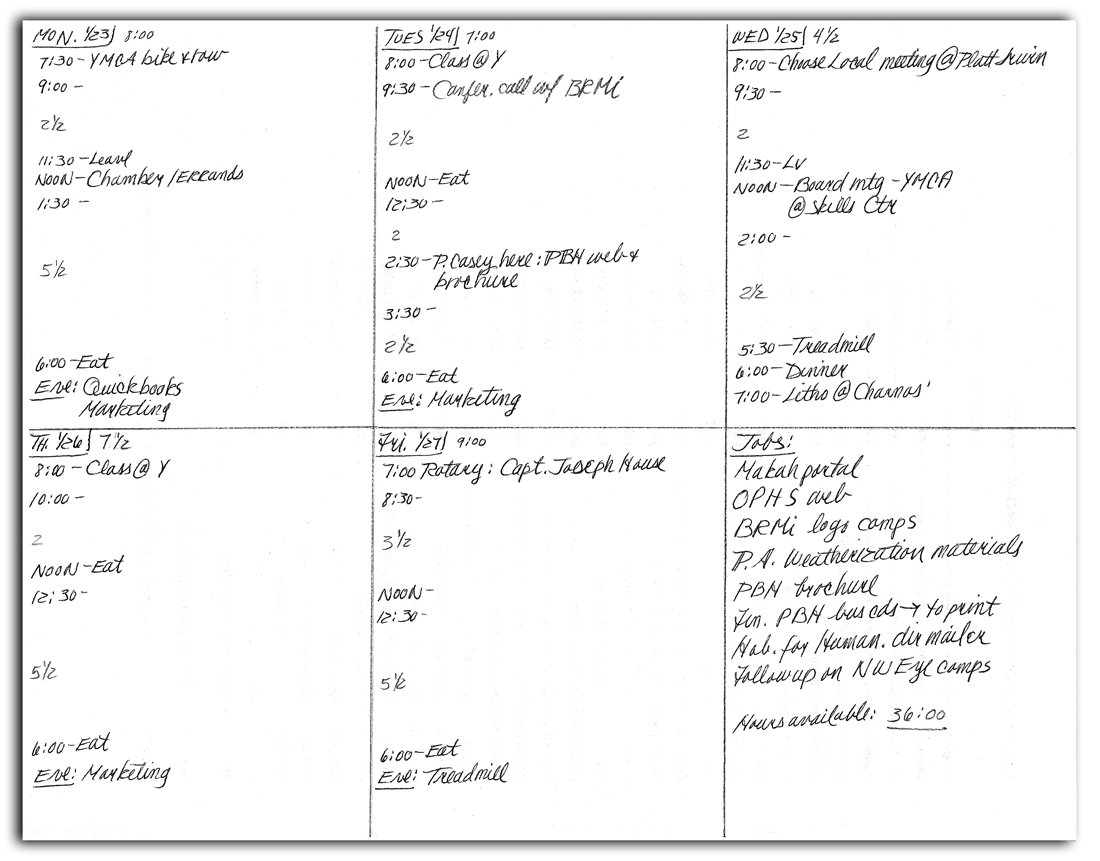
I seem to be off to a rocky start with my 2012 goal to write blog posts regularly, so some thoughts on time management seemed appropriate. Even with all the new devices and apps for managing time, we can still feel overwhelmed with the sheer volume of our To-Do’s, relative to the amount of time we have to do them in. Planning is the best way to avoid where-do-I-start paralysis, and keeping it uncomplicated is always better than overthinking. Here's a dirt-simple method that has stood me in good stead for years. In essence it is a semi-fancy list.
At the beginning of every week, I take a piece of paper out of my printer and fold it into thirds and again into half. I then have 6 squares. Five are labeled Monday through Friday with their respective calendar dates, and the sixth is where I put a list of job tasks that have to be worked on that week. I then prioritize those in order of how soon they're due by numbering them. Then I look in my day planner for meetings, deadlines, etc. and write them down with their hour times in the appropriate day box. I include things like when I'm going to go to the Y and anything else that is important (like a doctor’s appointment). I now have the whole week spread out in front of me and I can see at a glance how much work time I have (provided I don't goof off playing Minesweeper and reading blogs). As things come up, I erase and revise. Easy peasy. Takes about five minutes, nothing to install and it never crashes.
Yes, I know it is paper-based and seems dorky, especially when everyone else is tapping away on their devices. But the short act of doing this gives me a sense of order and control that makes it easier to get to work. All I have to do to get going is that one thing at the top of the list - take that, paralysis! The physical act of writing makes it real. I have a simple visual I can carry around in my pocket for fast reference, and it boots up really fast. I find it empowering and calming at the same time. Consider giving it a shot.